Listen/watch our EPOCH Exchange podcast episode below:
Released April 2026 | Duration: 31:06
In this podcast episode, Sarah and Erica are joined by Andrea Bodo and Tom Zimmer, Waterstone of Lexington residents. Together, they discuss what life is like in the community as well as the reasons that brought them to independent living. They also share details of their involvement in local preservation efforts to support the Ellen Stone building in Lexington, MA.
We discuss:
- Andrea and Tom’s life stories and what brought them to Waterstone.
- How Waterstone has provided convenience and connections for both.
- How the activity schedule sparked their curiosity in a local preservation project.
- The work of the Lexington Lyceum Advocates (LLA), and their work to preserve and restore the Stone Building in Lexington.
- How Andrea and Tom got involved and where the project stands today.
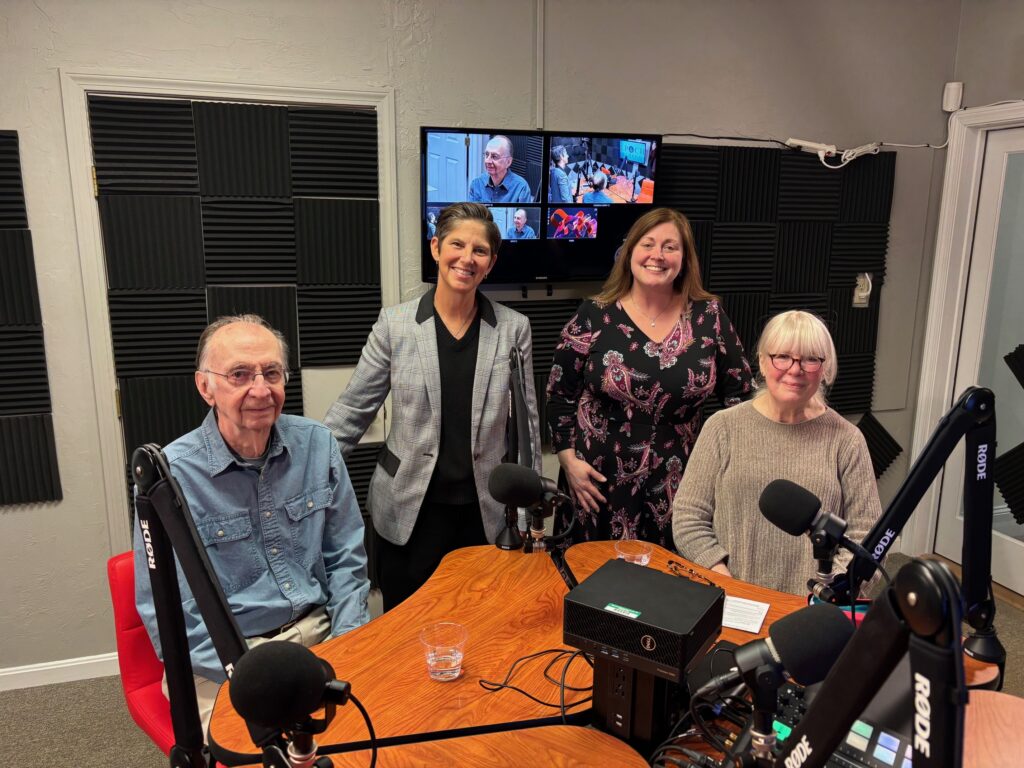
Guests:
Andrea Bodo and Tom Zimmer
Waterstone of Lexington residents
Episode Transcript
Welcome to The EPOCH Exchange, where we get real about senior living, dementia care, and everything happening in senior life today. I’m Erica Labb, Director of Team Member Engagement and Culture at EPOCH Senior Living. And I’m Sarah Turcotte, Area Community Liaison for our Bridges by EPOCH and Waterstone communities.
Whether you’re a caregiver, a professional, or navigating memory loss yourself or with someone you love, you’re in the right place. We’re here to share real experiences, practical insight, and the conversations that don’t always happen, but should. Each episode, we sit down with people who are making a real difference, from care team members to clinical experts and community leaders, bringing you a closer look at what’s happening every day in senior care and senior life.
Our goal is simple: help you feel more informed, more supported, and a little less alone along the way. And with that, let me introduce today’s topic and guests. Today, we’re looking at how purpose and community take shape in senior living.
Joining us, we’re thrilled, joining us today are Andrea Bodo and Tom Zimmer, independent living residents at Waterstone of Lexington.
Welcome.
Yes.
Thank you.
Andrea and Tom have been hard at work on a local preservation project with an advocacy group in Lexington, Massachusetts, and they’re here to share this mission. We are just so excited to welcome you to the show.
Yes, thank you.
Welcome.
Well, thank you.
Happy to have you.
So let’s start with a little explanation. As we said, Andrea and Tom, you are independent living residents at Waterstone of Lexington, so you’re both living in independent living. Could you kind of describe what that means for our listeners and viewers?
Because a lot of folks don’t understand what independent living is. So in your own words, could you explain what that looks like?
Yes. Pleased to do that. I think there are a number of elements that go into independent living. First of all, you’re in a facility that’s managed by somebody else, so they take care of all the maintenance, they take care of the landscaping, and you don’t have to do any of that.
If your dishwasher breaks, they take care of fixing that. So that’s one element that leaves you a lot of free time to devote to other things. And then in independent living facilities, normally there are certain kinds of amenities, like maybe a pool, a fitness center, and also, very importantly, the staff.
The staff at Waterstone of Lexington is really wonderful, very supportive. And then of course, there are the residents, who are really a big part of life at many senior living facilities. And I think that’s about it.
Andrea, do you have something to add?
I think one of the wonderful things, I haven’t cooked in three years. That sounds like heaven to me.
No more having-
I forgot to mention that …yes.
You did great, Tom.
No more having to plan and cook and clean, which takes time. So now I can do things of my choosing, and it’s pretty luxurious.
We get to sit in our white tablecloth dining room with four of our friends or more every single night. I would never have dreamed that my life would’ve turned out like this. And we have housekeeping.
We have maintenance. Anything you need, people will help you. We’re very independent.
It’s an apartment building. We have our parking, and we come and go as we please.
Mm.
We’re still very much a part of the community- … but we don’t have the chores.
I love that.
I really appreciate you sharing a little bit about what independent living looks like and some of the amenities that you enjoy. And I would love, before we dive into what we’re here to talk about today, is just maybe share a little bit more about yourselves and what life looks like for you as a resident at Waterstone.
Sure.
My husband and I moved to Waterstone three years ago. He was a retired engineer. I was a retired nurse. And we became part of the community. My husband set up a luncheon group because he liked to be with other men rather than a table of women every single night. So he had a men’s group.
I was very interested in the arts, and after a year, I finally convinced our activities director to get us an art teacher, and I’ve been very invested in that. It’s a passion of mine. I can do whatever I please every day.
It’s amazing.
I get up, and I look at the calendar.
Nothing is urgent.
It’s a completely relaxed, luxurious lifestyle, really.
Aw, I love that.
And how about for you, Tom?
Well, pretty much along the same lines that Andrea mentioned. Obviously, given all the support that’s available, that leaves us with more time, and importantly, I think, also more energy because we’re 75, 80, 85.
We won’t say who’s what.
Yeah.
And we don’t have as much energy as we used to have, so you kind of harvest that a bit, but that allows us the opportunity to go to the fitness center and spend some time there, and engage in the activities that we want to engage in. I was a resident of Lexington with my wife for many years. So, I still have friends in the community. I get out to see them and so forth.
That’s right.
And they’re welcome in, right? I mean, independently-
Yeah … it’s like being home.
Your friends are welcome, correct?
Always welcome.
Yeah.
Yeah.
And sometimes I invite them, and we have dinner at Waterstone also, which is really nice and easy. And then sometimes we go out too. So, it leaves us time and energy to do the kind of things that we want to do.
Yeah.
And that raises such a good point that I hadn’t really thought of so directly, but I know you both historically have been very busy people in careers and life and all that, right? And so now you’re not busy doing dishes or doing the housekeeping or doing the meal prep because you have a chef that does that, right? But you’re now, and this is what we’re going to get into today, how are you spending your time? And it’s still important. The stuff you’re doing is still so super important, and you have the energy to do it, and that’s kind of what we’re going to lead into today, is a very special project you’ve been working on, we’re truly excited to learn more about. But because you have the bandwidth, these are the types of things you can do for the community. So.
Yes, definitely.
And I also want to mention, both Tom and I lost our spouses. My husband died two years ago, so I had to redefine a life for myself. The support in this community was just unbelievable.
And several people had passed, and I didn’t want it to be depressing. My husband lived to be 84.
Mm.
I did a celebration of his life on a PowerPoint for the community, and it was a very positive experience. Gained all kinds of friends and support, and now I can go on and do my life. And it looks a little different than before.
Looks a little different. I’m sorry for your losses.
We both are. Yeah. Absolutely.
But thank you for sharing that, because that’s a reality. Our lives change a lot. But you’ve been able to kind of pivot and get the support you need.
Well, I often thought if I had stayed in my previous life, living alone in a house in a small town, I would’ve been alone the whole time. Down here, people couldn’t have been kinder, making sure you’re okay, bringing you flowers, coming to invite you to meals, and that’s terribly important as you go through the process of losing a loved one. And then what do you do from there kind of thing.
Right.
And that loneliness that can ensue.
Mm.
I’ll just add something to that also along the same lines. I lost my wife about a year and a half ago now. And part of the reason that we decided to move to a senior living place was that we came to the realization that probably the two of us were not going to die at the same time.
And so that meant one of us, more than likely, would be alone after the first person died, and that’s what happened. And so a senior living place for us, and for me, as a survivor, was really great in that I had the support of the community, and now I had this group of friends, residents, interesting people with very interesting careers. And so that’s been a great comfort to me after my wife died.
And thank you for sharing that. Your spouses were known in the community before they passed, which I think is for so many of us is so important. Rather than moving in after we lose someone, and then you’re going through the grief of the loss plus the change.
Yeah.
It’s kind of if– I mean, nobody wants obviously, to lose their spouse, but your spouse was known to the community, and so they were grieving the loss as well.
Yeah.
Absolutely.
And I’ll tell you, social connectedness, community, it is so important as in all parts of our life, but most especially as we age. So social engagement and connectedness is actually one of the top things we can do for proactive brain health.
So, I really appreciate you guys sharing that, and when I think about how good it is for us. And really just kind of lending into how you’re staying involved with the community, I know we’re here to talk more about your involvement with the Lexington Lyceum Advocates group that you support, and I would love for you to take time to just take us back how this all began for you, and share with us a little bit more about the Lexington Lyceum Advocates.
Well, maybe the way to start that conversation is Lexington Lyceum Advocates is working on the preservation of the so-called Stone House, which is in East Lexington, and trying to find a way in order to find a revitalization of the Stone House and a reuse of it.
The Stone House is not actually a stone house. It’s a wood-frame house. And the name comes from the granddaughter, Ellen Adelia Stone, of the builder of the Stone House, Eli Robbins, and the Robbins family.
The house was built in 1833, so it’s old. And it was used and built initially for potential residents on the first floor and a lyceum space on the second floor. And the lyceum was a new movement, which actually began in Massachusetts in around 1826, and the idea was to provide a space, and um, um, speakers and lecturers who could come in and give interesting, um, programs, provide a space for people to meet and share ideas and knowledge.
And, uh, the motivation was basically, uh, adult education because there were no public schools at the time, uh, and this was a way in which new voters who were getting the right to vote could be, uh, educated a bit and to make them more knowledgeable voters. So that’s kind of the origin of the Stone House.
Wow, that is definitely interesting stuff. So, can you just also share a little bit more? This is important work it sounds, what you guys are doing, and I’d love for you to share more about why the work of this group matters and what are you mainly hoping to preserve?
Um, I would just like to go back a little bit. We have an incredible activities director at Waterstone, Susan Dearborn.
Oh, she’s the best.
She brings the most interesting people, and she brought the Lexington Lyceum Advocates to come and speak at Waterstone in the Lexington Room.
And that was before either of you were involved, right?
Yes.
Okay.
And going back a little farther, in 1995, my husband and I were both at MIT. We retired to Durham, New Hampshire, and we had three properties in the National Register Historic District. I knew nothing about it.
One night at dinner, one of the neighbors said, “Join the Historic District Commission.” And I thought, “I can’t do that,” but I did. And I was with them for 17 years.
Yeah.
I managed to figure out with them how to get buildings on the National Register, how to preserve our dam. I was so invested in historic preservation, you could not live with me. My husband was just beyond as well.
So, when we came down here, the first thing Steve said was, “Please don’t get involved in another historic preservation project.” So, a year and a half later or whatever, Susan brings these people, and they’re very charming people. Mark Manassas, who’s the president, and all of these intellectual professors of public history, came and talked about the building. And there was the building, and that building spoke to me.
It needed to be advocated for. It needed help with preservation. And this group is very intellectual and very research-oriented, but none of them had ever been on a National Register Historic District Commission before, so they didn’t know the ins and outs of the bureaucracy, and I felt that was something that I could offer to them.
So, we left the Lexington room. Tom and I were walking in the hall. We said something like, “Isn’t that an interesting project?” As you know, Tom said that to me, and I said, “Would you like to join with me?” And he said, “Sure.” So here we are, a year plus later, um, and we spoke to Mark and the group, and we said that we would be willing to volunteer and to help.
I don’t think they knew what we could offer, but I had the historic preservation background. Tom’s a retired corporate lawyer and a resident of Lexington. So, we jumped in.
We got invited to board meetings. We got invited to the presentations. We got invited to the East Lexington Fair. We were hooked.
Yeah, we were hooked. As I said, I lived in Lexington with my wife. Lived in Lexington, uh, pretty close to the Battle Green, and so you can’t avoid being involved in the history or at least interested by it.
And then we moved, for a number of years to Plymouth, and in Plymouth, I was involved with the Pilgrim Hall Museum, and I became a trustee at the Pilgrim Hall Museum and became very much involved in the early Pilgrim history and so forth. So, I had an interest in history and historical things, and Andrea and I kind of teamed up and got involved in it, so.
So cool that you are taking not only your passion, but your life skill set, and still being able to utilize this after being retired.
We revived it. Last summer was a turning point, I think, because the group, are there but seven or eight people in the Lyceum Advocates group, I guess? I think a couple more than that, actually.
Really?
Yeah. So, we’re having a board meeting, and they’ve been doing this for several years and not getting anywhere. They were trying to get the attention of Lexington and trying to get an RFP. And I suggested that when I worked up in Durham, and we tried to get the attention for putting our dam out in the public, that there’s a program that’s modeled after the 11 most endangered historic resources in the nation.
Each state has something, and in New Hampshire, we had Seven to Save. So, of course, I got involved in that, and I listed our dam on Seven to Save. The town administrator was not particularly thrilled. The town owned the dam, and here was all this publicity. They’re not fixing it. What are we going to do?
So, I said, “We should look into it down here. We have Preservation Massachusetts.” So, Mark said, “Well, you want to try to do the application?” So, I said, “Sure.” So, Tom and I worked on the application. We brought it as far as we could.
We gave it back to the people on the board. They finished it.
Lo and behold, we were accepted on the 2025 Most Endangered Historic Resource in Massachusetts. We had a lovely event at the Lyman Estate in Waltham, meeting other people, and Tom and I played an important role of getting them to that next level in getting the publicity that they needed to make this public.
Oh, that is incredible work, isn’t it? Yeah.
And it goes back to like, you had the capacity to do that. You brought your talent to the community. Like, it’s such a great example, I think. And we talked a little bit before today’s show about, um, a comment that someone made about you two joining the group. Would you share that story?
Yeah. I think it was at the meeting last summer, and people were commenting that somebody in the group was going to do this application but never quite got around to it, and they were glad to have a breath of fresh air come in to do this. Well, those people are in their 50s and 60s, and Tom and I are more octogenarians.
Yes. And you’re the breath of fresh air.
Yeah.
Which is so great to hear that. Like, we’re in such an ageist society. I mean, I find myself doing it all the time, making jokes about aging, and it’s like you’re the breath of fresh air. Not the 25-year-old, right? It’s y’all are the breath of fresh air, which-
Well, I think we have the enthusiasm and passion. They’ve been working for years on this.
Right.
And we were able to bring in new eyes and, um, our backgrounds. We were able to contribute something a little bit different.
Right. You have the experience.
Yeah, that’s incredible. And maybe I should interject here, why there’s an issue here with the Stone building.
Yeah.
Um, so in 1892, uh, Ellen Adelia Stone deeded the building to the town of Lexington at a very reduced price, which is why the town then decided to call it the Stone Building. Uh, and for almost 100 years after that, the building was used as the East Lexington branch of the Cary Library in Lexington.
Okay.
So it was a library for many years, until in 2007, uh, there was a flood in the building and damaged the building, and the building has been vacant and unused since 2007. And the issue is it should be preserved because of all of its history, um, which we probably need to go into a little bit more. Um, but it’s a budgetary issue in the town.
Sure.
Um, there are a number of budgetary issues. So, part of what Lexington Lyceum Advocates is trying to do is find a way in which to generate interest in the building, the revitalization of the building, and reuse as a lyceum-type property and meeting space. So that’s the issue, and that’s what the group is involved in.
And that’s kind of current time, what you’re looking to do.
Yes.
That’s like what you need now.
Yes.
And a little bit about the history, Tom, jump in.
Um, Eli Robbins was an abolitionist, and he brought abolitionists to come and speak at the Lyceum. This was a really hot topic in Lexington. Personally, I did not realize there were slaves in Lexington and Acton and all around here.
A lot of people don’t know that. Right. At that time.
Yeah.
So, it was quite interesting. And then the transcendentalists, our friends Ralph Waldo Emerson and Thoreau, they all came to speak in the Lyceum. The suffragettes came to speak, and Ellen Adelia Stone, who was the granddaughter of Eli Robbins, never married, never had children, but she was passionate about these causes, and she exists in the monument that’s downtown on the green.
She’s the child that’s holding onto her sister, Julia Robbins, who was also a suffragette.
I love this history lesson right now.
Yes. Makes me want to go back to Lexington and walk around again with fresh eyes. I missed all the history when I was in school, I think.
Yeah.
I’ll just add one more thing, because Andrea mentioned, uh, Ralph Waldo Emerson as a speaker there. Um, the building was actually used for a period of time, um, before Fallon Church next door was built on land donated by the Robbins family, and the Fallon Church is actually a fairly interesting historical building also.
Ralph Waldo Emerson actually was the kind of part-time minister in the Stone building for the East Lexington community at that time. So he was kind of the minister for almost three years before the Fallon Church was built next door.
Mm.
Wow.
Wow.
That is a lot of great– I mean, I feel like we could talk a long time about this, but I would love for the audience to know where are you now with your preservation efforts, and what are people working towards right now with this project? And do you have a need? Do you have an ask at this point?
Well, there’s definitely a need. Um, and-
6 million of them.
Let me get my checkbook.
Yeah.
So, um, LLA, Lexington Lyceum Advocates, has been working with the town and trying to find a way in which to get the resources and interest to renovate the building, which is not an inexpensive proposition because it’s a historic building, and there are all the rules that you need to follow about restoring historic properties. Uh, it is on the National Register of Historic Properties. Um, and then you have to upgrade it to code and so forth.
So, it’s an expensive proposition. And, uh, the group has been, uh, trying to find a way to re-work with the town to raise those funds. It’s a bit in a stalled moment right now in that respect, unfortunately.
But people are working diligently to try and find a path to success here.
Okay. Sure.
One of the things-
Go ahead, Andrea …
I think there’s a tremendous need to educate the public about this building. I think people don’t realize the building and its history. Tom lived in Lexington for years and didn’t know about it. You have to sort of fall in love with a building before you start donating to it or whatever. And by listing it on the Most Endangered Historic Resources, we can have access to public media, to television, whatever.
We have pictures and photographs and so forth so that people realize the building they’ve been driving by on Mass Avenue for years, is significant, and it’s abandoned, and it needs to be elevated to its historic stature. I’m new to Lexington, even though I lived over in Belmont, but we’re all about the Revolutionary War here.
Right.
But now we’re talking about the next century of history, which is fascinating. And I’ve talked to more people at dinner at Waterstone, Tom probably too, nobody realized the history that’s gone on around here.
Right.
And it’s American history. It’s not just Lexington history.
Right.
And if we can be a part of that, I think that’s very exciting. So, I’m hoping to get more visibility for the building, trying to get the picture out, trying to get people in our local newspapers here, and so forth, so that people know what the building looks like.
But also, I cannot believe that I’m living two miles away in Waterstone in Lexington from where abolitionists, transcendentalists, and suffragists spoke.
Right.
I mean, that’s just incredible. You walk by these buildings, and if they could speak themselves, what a history.
Right.
Oh, absolutely.
And I feel like you’ve already started these efforts, bringing exposure. I would love for you to share with the audience, while we still have some time, a little bit about the exhibit and the gallery that you put together at Waterstone of Lexington about this.
Yeah.
We’re going to get pictures of this up for people.
Okay.
I can speak to that. Susan, our activities director, I go and chat with her all of the time, we all do, told her that we got the nomination on the Most Endangered Historic Resources list, and she said, “Let’s have a champagne event.” Well, we didn’t because it was last October, and we didn’t know where we were going with all of this. But then she suggested that we do an exhibit for our gallery.
So, Tom and I thought that was a great idea, and I worked with the people from the Cary Library, the Lexington History Museums, to get these photographs and so forth, to put an exhibit together, an educational FYI exhibit.
Right in the lobby of your-
In Gallery 55. Yeah.
Yes.
Oh my gosh.
And people actually went in and read it and looked at it. And then we had a gallery talk, and Mark Manassas, who’s the president of the Lexington Lyceum Advocates, gave a wonderful, dynamic talk. And Tom gave the history of all this there. I could just go on. It’s endless.
And the support that you got where you live, in your community, and then being able to share it with all the folks you live with there and-
Living in an environment like we do, and we have so many interesting and interested people.
Right.
The staff was interested. The dining room people wanted to put on a buffet, a marketing buffet or something. Fred was very excited about all of this.
I mean, that’s-
And Fred is your executive director there.
Yes. Yep. Fred is our wonderful executive director. But to have all that support and enthusiasm, it’s like going home and telling your parents and your siblings what you’ve just done, and they’re excited. So it’s a wonderful environment.
I’m very uplifted again. I felt this way a number of years ago when we were doing this with our dam in New Hampshire, and I never thought I’d feel that again, but I do.
You both are such an inspiration.
Yeah.
And I said this before privately, but you truly are such an inspiration of what it means to invest in your own community and put your time and talents where they’re most needed. So we really appreciate the time you gave us today.
Well, thank you.
Yes.
A true reminder not to underestimate how older adults can still contribute and be a part of their greater communities. Truly, hats off to you both.
Mentally, I feel younger. Structurally, things are a little-
You seem great.But being offered this opportunity has been so thrilling to me, and to be able to work with Tom, he’s so easy to work with and fun to work with. And I think we’re kind of a team that’s infectious because other people want to hear about it, too, and get involved in it.
Yeah.
You got us hooked. We’re planning our trip to Lexington right after this.
Yeah.
A little field trip.
Yeah.
It’s been a great experience for me, too, working with Andrea and the others in the group.
By the way, The Lyceum Advocates put on regular programs in town on issues that you would not normally be talking about in town halls or whatever. There’s some areas of controversial issues as they had in the Lyceum.
Right.
So, if you go to lexlyceum.org, there’s a webpage that tells all about this, tells the programs and the future events, and there’s also a donation portion of it if you’d like to be a friend of the Lexington Lyceum. That’s fantastic, and you don’t need to live in Lexington to do that.
Yeah.
So, we welcome everyone to check it out.
Well, I can’t thank you enough for sharing more about your experience being a Waterstone resident, as well as the great work you’re doing in the community. It’s truly an honor to be here with you both.
Thank you.
Well, thank you.
Thank you for making this possible.
Yes. It’s wonderful.
And I hope our listeners enjoyed this program. There was a lot to learn, and hopefully you’ll see how you can be a part and help, too. But until the next time, we thank you for being here.
Farewell.
See you soon.
Take care.